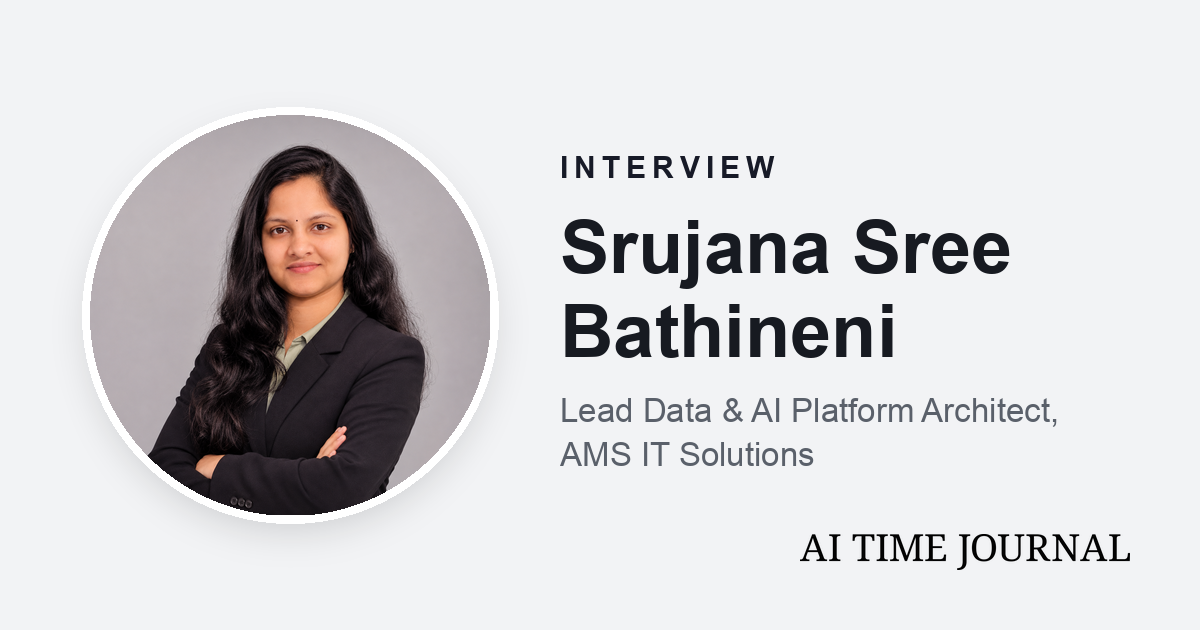
In this AI Time Journal Q&A, we spoke with Srujana Sree Bathineni, Lead Data & AI Platform Architect at AMS IT Solutions, Inc. As the sole architect and primary developer of the AMS BackOffice Inventory Module, she was responsible for its overall architecture, database design and core business logic. The module brings together invoice processing, expiration monitoring, waste reporting, vendor credit tracking, stock intelligence, promotional recommendations and AI-assisted ordering for small and independent retailers. She explains where business rules, analytics and AI each belong in retail inventory management, and why AI recommendations should support the retailer's judgment rather than replace it.
What first convinced you that small and independent retailers needed more than conventional inventory reporting? Can you describe a recurring operational problem that helped shape your vision for the AMS BackOffice Inventory Module?
I think what stood out to me most was that inventory management in smaller retail businesses involved much more than simply knowing how many products were available on the shelves. There were several everyday challenges happening behind the scenes that traditional inventory systems did not really address.
For many convenience stores and independent retailers, managing inventory was still a very manual process. Employees had to keep track of products, maintain purchase records, monitor expiry dates, keep track of moving items, and remember which products might qualify for vendor credits. Much of this depended on spreadsheets, physical inspections, and employees remembering to perform these tasks regularly.
One recurring problem that particularly caught my attention was expiration management. A store could receive hundreds of products from different distributors, but keeping track of when each product would expire was a completely different challenge. Employees had to physically inspect shelves, check individual products, and maintain records to avoid missing expiration dates. Even with these efforts, products could still be overlooked.
What made this problem more significant was that an expired product did not necessarily represent just the cost of an unsold item. If that item ends up in a customer's hands and they notice it has expired, that does serious damage to the reputation of the business and the retailer. It could also mean a missed opportunity to receive a credit or reimbursement from the distributor. These were a few of the operational gaps that could gradually translate into financial losses.
I began looking at inventory management from a broader perspective. Instead of building another system that simply recorded stock quantities, I wanted to create something that could help retailers understand what was happening to their inventory throughout its lifecycle, from the moment products arrived at the store until they were sold, removed, or reported as waste.
That thinking became the foundation for the AMS BackOffice Inventory Module. My goal was to reduce the amount of manual effort required from store employees while making inventory information more useful for everyday business decisions. I wanted the system to do more than store information. It needed to actively monitor inventory, bring important issues to the user's attention, and help retailers take action before small problems turned into financial losses.
For me, that was the real motivation behind the project: making intelligent inventory management practical for small retailers who may not have dedicated inventory teams or sophisticated technology resources, but still need the ability to make informed decisions and run their businesses efficiently.
From receiving supplier invoices to tracking stock, sales, expiration dates and vendor returns, where did you find the biggest gaps in how store information was captured and connected? How did those observations influence the workflows you chose to build?
One of the biggest gaps I noticed was that inventory information was often fragmented across different business activities. Stores had information about purchases, stock levels, sales, expiration dates, and vendor transactions, but these activities were not always connected in a meaningful way.
For example, knowing how much inventory a store had was only one part of the problem. Store owners also needed to understand how products were performing, which items were approaching expiration, where potential losses were occurring, and whether there were opportunities to recover value through vendor credits. Much of this required manual effort and separate tracking processes.
I realized that simply improving inventory records would not solve the larger problem. What retailers needed was a more connected system that could bring these different aspects of inventory management together and turn the information into something useful.
This became an important principle in my approach to developing the Inventory Module. Rather than treating inventory tracking, expiration management, waste reporting, and vendor credits as isolated functions, I focused on bringing them together within a unified platform. My intention was to move inventory management beyond record keeping and make it more proactive, giving retailers better visibility into their operations and helping them identify issues and opportunities before they became costly problems.
As the lead architect, what were the most consequential technical design decisions behind the Inventory Module? How did you keep the system practical for smaller retailers?
One of the most important decisions I made was to design the Inventory Module as a unified platform rather than a collection of separate inventory features.
As the sole architect and primary developer, I was responsible for shaping the overall architecture, database design, and core business logic. I wanted to ensure that the different inventory functions could work together while leaving room for future analytics and AI-driven capabilities.
Another important consideration was making the system practical for smaller retailers. I understood that store employees should not have to spend more time managing software than managing their actual operations. So I focused on simplifying everyday workflows, reducing repetitive manual activities, and presenting information in a way that could support quick business decisions.
Rather than introducing complexity for the sake of technology, my approach was to build a system where automation and intelligence addressed actual operational problems. This also meant creating a foundation that could evolve as we expand our analytics and AI capabilities.
Ultimately, my biggest design priority was balancing three things: a reliable technical foundation, practical usability for retailers, and the flexibility to support more intelligent inventory management in the future.
What can the Inventory Module do today, and which intelligent capabilities are still being developed or explored? Where do rules-based automation, analytics and predictive models each make sense, rather than using AI for its own sake?
Today, the Inventory Module brings together several important aspects of inventory management, including invoice processing, expiration monitoring, waste reporting, vendor credit tracking, stock intelligence, and promotional recommendations. It helps retailers move beyond simply viewing inventory numbers and gain a better understanding of how their products are performing and where they may need to take action.
I believe that technology should solve actual business problems rather than introducing AI simply because it is a growing trend. For example, certain tasks, such as monitoring expiration dates and generating timely alerts, are better handled through automation and clearly defined business rules. Analytics helps retailers understand product performance, while predictive capabilities can support better demand forecasting and purchasing decisions.
We also take retailer feedback into account in product decisions. Sometimes even an individual retailer identifies a functionality that would make their daily operations significantly easier, and we evaluate how it can be incorporated into the product where appropriate.
We have already incorporated AI-assisted inventory intelligence into AMS, including product recommendations. This helps retailers make more informed purchasing decisions rather than relying entirely on guesswork or manual calculations. We continue to explore ways to make these capabilities more useful by improving forecasting, inventory optimization, and decision support. My focus is on ensuring that AI recommendations are practical, understandable, and aligned with the actual needs of retailers.
Walk us through a concrete inventory decision the module is intended to improve, such as identifying slow-moving stock, handling products approaching expiration or recovering vendor credits. How does that differ from their previous workflow?
One example is how retailers handle products that are approaching their expiration dates. Traditionally, employees had to identify these products through regular physical inspections and then decide what to do with them. Sometimes, by the time a problem was noticed, the opportunity to sell the products or recover their value through vendor credits had already passed.
With the Inventory Module, retailers have better visibility into products approaching expiration through centralized monitoring and timely notifications. Depending on the situation, they can then consider different options for what to do with those products.
What I find most valuable about this approach is the shift from reacting to inventory problems after they occur to identifying opportunities and taking action earlier. The system does not replace the retailer's judgment; it gives them better information to make decisions with greater confidence.
How do you evaluate whether inventory intelligence is delivering real operational value? Which measures matter most, such as time spent reconciling stock, inventory accuracy, avoidable waste, stockouts or cash tied up in inventory?
For me, the success of an inventory management system should not be measured simply by the number of features it offers. What matters is whether it makes a meaningful difference in how retailers manage their daily operations and make business decisions.
One example I often think about is when a new manager takes over a retail store. Someone who has been managing a particular location for one or two years gradually develops an understanding of its customers, purchasing patterns, popular products, and seasonal demand. A new manager may receive some guidance from the previous manager, but it takes time to develop that same understanding.
This is where inventory intelligence can make a difference. Through the AMS Inventory Module, managers can access sales patterns, product performance insights, and AI-assisted recommendations on what products to order and in what quantities. These insights are available whenever they need them, allowing even a new manager to review inventory recommendations regularly and gradually understand which products are performing well at that particular location.
I see this as an important benefit because the system helps make historical business knowledge more accessible instead of leaving it entirely dependent on an individual's experience.
Beyond purchasing decisions, I also look at improvements in employee efficiency, inventory visibility, waste reduction, and vendor credit recovery when evaluating the module's value.
The Inventory Module incorporates AI-assisted ordering recommendations. How does this capability help retailers make better purchasing decisions, and what do you believe is the role of AI in helping retailers manage their businesses more effectively?
I believe one of the biggest advantages of bringing AI into retail operations is its ability to turn historical business information into useful guidance for everyday decisions.
Traditionally, purchasing decisions in smaller retail stores often depend heavily on the experience of the store manager. Managers learn over time which products sell consistently, which items move slowly, and how much stock they should maintain.
With the AI-assisted ordering capability in our Inventory Module, we are making that process more data-driven. This gives retailers an additional source of guidance when planning their purchases.
I see AI as a way to support human decision-making rather than replace it. Retailers understand their customers and local market conditions, while the system can identify patterns in business data that might otherwise take considerable time to recognize.
My approach has always been to make AI practical. A recommendation is valuable only when it helps someone make a better decision in their daily work. The objective is not to make retail operations more complicated with advanced technology, but to make useful business intelligence accessible to retailers regardless of their technical expertise.
What happens when source data is incomplete or an automated recommendation is wrong? How would you design human review, auditability and safeguards so that store operators can trust the system without losing control of purchasing decisions?
One thing I strongly believe is that AI recommendations should never be treated as unquestionable decisions, especially when they directly influence a retailer's purchasing and financial decisions.
Inventory data can sometimes be incomplete, inconsistent, or affected by unusual sales patterns. For example, a product may suddenly experience higher sales because of a local event or promotion. If the system interprets that pattern without considering the broader context, its recommendation may not always reflect what the retailer actually needs.
My approach is to treat AI-generated recommendations as decision support tools rather than automatic instructions. The retailer should always have the ability to review the recommendations, consider their own understanding of the business, and make the final purchasing decision.
I also believe that the quality of the underlying data is just as important as the intelligence built on top of it. If inventory and sales information are not reliable, even a sophisticated recommendation system can produce misleading results. This is why data quality, validation, and continuous system improvement are important considerations when developing intelligent business applications.
Building trust in AI is not just about how accurate its recommendations are. It is also about making those recommendations understandable, keeping the retailer involved in the decision-making process, and ensuring that technology supports rather than replaces human judgment.
For smaller retailers in particular, trust is essential. They need to feel that the system is helping them run their businesses, not taking control away from them.
Smaller retailers often have limited budgets, inconsistent data and little time to adopt new systems. How do those constraints change the architecture and user experience? What makes an intelligent inventory tool accessible in practice rather than another operational burden?
One of the important considerations when building technology for smaller retailers is that it has to be practical, both financially and operationally. Many independent retailers do not have dedicated technology teams or the resources to manage multiple complicated systems.
That is one reason we developed the Inventory Module as part of the AMS BackOffice platform rather than as a separate product. Retailers can access inventory management and intelligent capabilities within the same platform they use for their other store operations.
From a product and architecture perspective, I focused on making the information useful and easy to act on. A store manager should not need advanced technical knowledge to understand product performance or make purchasing decisions.
I also believe accessibility is not just about the cost of software. It is about how much time and effort a retailer needs to invest to get value from it. If technology adds complexity to an already busy operation, it misses its purpose. My goal was to make intelligent inventory capabilities available to retailers in a way that fits their day-to-day operations.
Looking ahead, how do you see AI-assisted inventory management evolving from better visibility to more proactive decision support? What would you prioritize next, and what should retailers remain skeptical about as vendors promise increasingly autonomous operations?
I see the future of inventory management moving from simply showing retailers what is happening in their stores to helping them understand what is likely to happen next and what actions they can take.
We have already taken steps in that direction with the AI-assisted ordering capabilities. Looking ahead, I would prioritize improving accuracy, strengthening forecasting, and helping retailers identify potential issues earlier.
At the same time, I don't believe retailers should rely blindly on promises of fully autonomous AI. Store operations involve factors that data may not always capture, such as local customer preferences, unexpected events, and changes in demand. AI should help retailers make more informed decisions, but human judgment will continue to matter.
Ultimately, I believe the real value of AI in retail is not how much of the operation it can automate, but how effectively it helps people make better decisions and run their businesses with greater confidence.
Product capabilities described in this interview are as reported by AMS IT Solutions.